
 Español
 Français
 English
#StandAsMyWitness
-
Nouvelle période stratégique de CIVICUS : Un temps pour engager activement les membres et nos alliés


Un message de Lysa John, secrétaire générale de CIVICUS
Chers membres et alliés de CIVICUS,
Ce 1er juillet, nous démarrons une nouvelle période stratégique pour l'alliance CIVICUS. Dans cette mise à jour, je souhaite partager avec vous les principaux développements dans nos efforts pour aligner notre travail et analyser les résultats dont nous avons besoin par rapport à nos priorités stratégiques pour la période 2022-2027.
La 11ème édition de notre rapport sur l'état de la société civile a été publiée le 27 juin et a reçu une réponse stimulante. En plus de bénéficier d'une forte couverture dans les médias sociaux, le rapport a été utilisé pour générer des articles d'opinion sur des questions pertinentes et pour fournir des présentations à un large éventail de réseaux d'activistes, d'universitaires et de donateurs. Depuis sa publication, nous avons été largement reconnus pour notre évaluation des métatendances de l'espace civique et de la démocratie, et pour la présentation d'exemples où et comment la société civile a réussi à influencer le changement. Les résultats du rapport ont été couverts par les médias, notamment par un éditorial de notre rédacteur en chef, Andrew Firmin, et une analyse de Mandeep Tiwana. La liste de surveillance de CIVICUS Monitor a également été mise à jour au cours de cette période et comprend le Tchad, la Hongrie, le Kazakhstan, le Kenya, le Mexique et le Sri Lanka.
Cette année, la Journée Nelson Mandela (18 juillet) a marqué les deux ans de la campagne #StandAsMyWitness. L'objectif de cette initiative est de mobiliser le public et les décideurs politiques pour qu'ils agissent en faveur de la libération des prisonniers d'opinion. Cette campagne a permis de faire connaître plus de 20 militants détenus et de contribuer aux initiatives mondiales qui ont permis la libération de neuf défenseurs. À l'occasion du deuxième anniversaire de la campagne, un dialogue a été organisé avec des activistes et des réseaux liés à la campagne, ce qui a permis d'obtenir des informations importantes sur la manière dont nos efforts collectifs pourraient mieux contribuer aux luttes des défenseurs des droits humains. Notre équipe a également participé activement à la 50e session du Conseil des droits de l'homme au cours de cette période. En plus de contribuer et de soumettre d'importantes déclarations, nous avons activement participé à l'expression des demandes de la société civile sur le processus d'élection du prochain commissaire aux droits de l'homme de l'ONU, en demandant à l'ONU de renouveler son mandat d'experts sur l'orientation sexuelle et l'identité de genre, et en contribuant aux processus qui ont conduit à l'adoption d'une nouvelle résolution sur le droit de manifester pacifiquement.
La campagne "Révolution de la solidarité avec les militants" a reçu un soutien et une attention considérables au cours de cette période. Les mises à jour des dialogues locaux et des "jam sessions" qui ont eu lieu dans cinq pays ont été partagées en ligne par une série de participants, y compris des jeunes leaders, des réseaux de base et des donateurs. Les réflexions sur les leçons à retenir de cette initiative formulées par des participants et des contributeurs tels que Dumiso Gatsha, Otto Saki et Yessenia Soto ont représenté une occasion importante de réfléchir aux questions et aux défis mis en lumière par cette initiative, ainsi qu'à sa capacité à servir de catalyseur pour une introspection plus profonde et plus difficile sur les valeurs individuelles et institutionnelles, essentielle à la concrétisation du discours sur la localisation et la décolonisation. Dans ce contexte, nous avons le plaisir de vous faire part de la réponse de 1289 organisations du Sud à la lettre conjointe adressée à l'administratrice de l'USAID, Samantha Power. La réponse, signée par Mme Power, reconnaît les priorités soulevées dans la lettre conjointe et décrit les initiatives prises pour renforcer l'engagement direct de l'USAID et son soutien aux acteurs de la société civile locale. Ces changements ont également été réaffirmés comme une priorité lors du dialogue sur la démocratie organisé entre l'administratrice de l'USAID et les dirigeants de la société civile le 16 juin.
Parmi les nouveautés apportées par le réseau, citons le lancement du rapport de l'équipe d'action jeunesse de CIVICUS sur les tendances des jeunes en matière d'activisme et d'espace civique, et la consultation de la coalition VUKA ! avec le rapporteur spécial des Nations unies sur les défenseurs des droits de l'homme afin de contribuer à son prochain rapport thématique sur les défenseurs des droits de l'homme travaillant sur les questions de migration, de réfugiés et d'asile. En juillet 2022, a eu lieu une réunion conjointe des réseaux régionaux travaillant ensemble dans le domaine de la liberté de réunion pacifique (FoPA). La réunion a passé en revue les initiatives de collaboration organisées depuis 2021 dans le cadre d'un processus de cocréation avec six plateformes régionales afin d'identifier les besoins et les priorités spécifiques au contexte et de produire des ressources pour les soutenir en tant qu'interlocuteurs clés sur le droit à la manifestation pacifique.
La dernière de nos initiatives, CIVICUS Lens, nous a permis de rassembler les voix et les expériences de divers groupes de la société civile pour fournir une analyse et des perspectives en temps réel sur les tendances et les développements géopolitiques. Les articles publiés dans CIVICUS Lens, ainsi que d'autres initiatives de notre travail, nous ont permis d'établir des partenariats avec des plateformes de diffusion plus larges. Tout au long des mois de juin et juillet, nous avons publié de nombreux articles d'opinion et enregistré plus de 84 citations médiatiques sur des plateformes mondiales, régionales et locales, notamment Reuters, IPS, Open Democracy, The Diplomat, Afrika NewsRoom et El País.
Pour conclure, nous sommes fiers d'avoir récemment conclu le cycle de rapport Accountability Now pour 2021-22. Le rapport d'évaluation reconnaît la transparence et l'inclusion de CIVICUS dans la mise à jour du plan stratégique et souligne que CIVICUS est un partenaire apprécié et de confiance dont le travail est resté pertinent pour les membres à un moment où le contexte a changé très rapidement. Le rapport reconnaît également les efforts déployés pour offrir un environnement de travail sûr et équitable. Le processus d'examen a également permis d'identifier trois domaines clés à améliorer, à savoir : (i) l'amélioration des indicateurs que nous utilisons pour mesurer les progrès stratégiques ; (ii) l'amélioration de nos processus d'atténuation des risques ; et (iii) la sensibilisation du personnel et l'utilisation des mécanismes internes de règlement des griefs. Des actions visant à traiter ces domaines d'amélioration ont été identifiées et sont incluses dans ce résumé du processus qui a été publié sur le site web de CIVICUS.
Rien de tout cela ne serait possible sans l'engagement actif de nos membres et de nos partenaires. Nous vous remercions de votre soutien et nous nous réjouissons de votre participation continue aux travaux et aux résultats au sein de l'Alliance.
En toute solidarité,
Lysa John
Secrétaire général de CIVICUS
-
Nuevo periodo estratégico en CIVICUS: Un momento para involucrar activamente a la membresía y a nuestros aliados

Un mensaje de Lysa John, secretaria general de CIVICUS
Estimada membresía y aliados de CIVICUS,
Este 1 de julio, comenzamos un nuevo período estratégico para la alianza CIVICUS. En esta actualización, quiero compartir con ustedes las principales novedades de los esfuerzos que hemos realizado para alinear nuestro trabajo y analizar los resultados que necesitamos en relación con nuestras prioridades estratégicas para el período 2022-2027.
La edición número 11 de nuestro Informe sobre el estado de la sociedad civil fue publicada el 27 de junio y ha recibido una respuesta estimulante. Este informe, además de haber recibido un fuerte impulso en las redes sociales, ha servido para generar artículos de opinión sobre asuntos relevantes y para ofrecer presentaciones a una amplia gama de redes de activistas, académicos y donantes. Desde su publicación, hemos recibido un gran reconocimiento por la evaluación que hace el informe de las metatendencias en el espacio cívico y la democracia, y por mostrar ejemplos de dónde y cómo la sociedad civil ha logrado influir en el cambio. Los medios de comunicación se han hecho eco de las conclusiones del informe, como el artículo de opinión de nuestro redactor jefe, Andrew Firmin, o el análisis de Mandeep Tiwana. La lista de vigilancia de CIVICUS Monitor también ha sido actualizada en este periodo y en ella figuran Chad, Hungría, Kazajstán, Kenia, México y Sri Lanka.
Este año, en el Día de Nelson Mandela (18 de julio), se cumplieron dos años de la campaña "Conviértete en mi testigo" (#StandAsMyWitness). El objetivo de esta iniciativa es movilizar al público y a los responsables políticos para que actúen a favor de la liberación de los presos de conciencia. La campaña ha dado a conocer a más de 20 activistas detenidos y nos ha permitido contribuir a las iniciativas mundiales que han dado como resultado la liberación de nueve defensores. En el segundo aniversario de la campaña se organizó un diálogo con activistas y redes vinculadas a la misma, que aportó importantes ideas sobre cómo nuestros esfuerzos colectivos podrían contribuir mejor a las luchas de las personas que defienden los derechos humanos. Nuestro equipo también ha participado activamente en la 50ª sesión del Consejo de Derechos Humanos en este periodo. Además de colaborar y presentar importantes declaraciones, participamos activamente haciendo oír las demandas de la sociedad civil sobre el proceso de elección del próximo Comisionado de Derechos Humanos de la ONU, pidiendo que la ONU renueve su mandato de expertos en orientación sexual e identidad de género y contribuyendo a los procesos que han llevado a la adopción de una nueva resolución sobre el derecho a la protesta pacífica.
La campaña "Revolución solidaria para el activismo" ha recibido un apoyo y una atención considerables en este periodo. Las novedades de los diálogos locales y las jam sessions celebradas en cinco países fueron compartidas en línea por una serie de participantes, como jóvenes líderes, redes de base y donantes. Las reflexiones sobre las lecciones aprendidas de la iniciativa por parte de participantes y colaboradores como Dumiso Gatsha, Otto Saki y Yessenia Soto han supuesto una importante oportunidad para reflexionar sobre las cuestiones y los retos que está sacando a la luz esta iniciativa, y su potencial para servir de catalizador de la más profunda y difícil introspección sobre los valores individuales e institucionales que resulta esencial para llevar a cabo el discurso de la localización y la descolonización. En este contexto, nos complace informar de la respuesta que se ha recibido a la carta conjunta dirigida a la Administradora de USAID, Samantha Power, por parte de 1289 organizaciones del Sur. La respuesta, firmada por la Administradora Power, reconoce las prioridades planteadas en la carta colectiva y esboza las iniciativas que se están adoptando para reforzar el compromiso directo de USAID con los actores locales de la sociedad civil y su apoyo a los mismos. Estos cambios también se reiteraron como prioridad en el diálogo sobre la democracia organizado entre la Administradora de USAID y los líderes de la sociedad civil el 16 de junio.
Entre las novedades impulsadas por las redes se encuentran el lanzamiento del informe del Equipo de Acción Juvenil de CIVICUS sobre tendencias juveniles en el activismo y el espacio cívico, y la consulta de la Coalición VUKA! con el Relator Especial de la ONU sobre Defensores de los Derechos Humanos para contribuir a su próximo informe temático sobre los defensores de los derechos humanos que trabajan en cuestiones relacionadas con la migración, las personas refugiadas y el asilo. En julio de 2022 también se celebró una reunión conjunta de redes regionales que trabajan conjuntamente en el ámbito de la libertad de reunión pacífica (FoPA, por sus siglas en inglés). En la reunión se revisaron las iniciativas de colaboración que se han organizado desde 2021 como parte de un proceso de cocreación con seis plataformas regionales para identificar las necesidades y prioridades específicas del contexto y para producir recursos que les sirvan de apoyo como interlocutores clave sobre el derecho a la protesta pacífica.
La última de nuestras iniciativas, CIVICUS Lens, nos ha permitido recoger las voces y experiencias de diversos grupos de la sociedad civil para ofrecer análisis y perspectivas en tiempo real sobre las tendencias y los acontecimientos geopolíticos. Los artículos publicados en CIVICUS Lens, así como otras iniciativas de nuestro trabajo, nos han permitido establecer asociaciones con plataformas más amplias para su difusión. A lo largo de los meses de junio y julio, hemos publicado múltiples artículos de opinión y hemos registrado más de 84 citas en medios de comunicación de plataformas globales, regionales y locales, como Reuters, IPS, Open Democracy, The Diplomat, Afrika NewsRoom y El País.
Por último, es un orgullo haber concluido recientemente el ciclo de presentación de informes de Accountability Now para 2021-22. El informe de evaluación reconoce la transparencia e inclusión de CIVICUS a la hora de llevar a cabo la actualización del plan estratégico y pone en valor a CIVICUS como un valioso y confiable socio cuyo trabajo ha seguido siendo relevante para la membresía en una época en la que el contexto ha cambiado muy rápido. También se reconocen en el informe los esfuerzos realizados para proporcionar un entorno de trabajo seguro y equitativo. En el proceso de revisión se han identificado también tres aspectos clave de mejora, que son los siguientes: (i) Mejorar los indicadores que utilizamos para medir los avances estratégicos (ii) Mejorar nuestros procesos de mitigación de riesgos, y (iii) Aumentar la concienciación del personal y el uso de los mecanismos internos para presentar quejas. Se han identificado acciones para abordar estos aspectos de mejora, que se incluyen en este resumen del proceso que ha sido publicado en la página web de CIVICUS.
Nada de esto sería posible sin el compromiso activo de nuestra membresía y nuestros aliados. Les agradecemos su apoyo y esperamos que sigan participando en el trabajo y los resultados de la alianza.
En solidaridad,
Lysa John
Secretaria general de CIVICUS
@LysaJohnSA -
Pakistan: UN Working Group concludes Muhammad Ismail was targeted because of his human rights work


CIVICUS, the global civil society alliance, welcomes the conclusions adopted by the United Nations Working Group on Arbitrary Detention that found the arrest and detention of Muhammad Ismail arbitrary and calls on the Pakistan authorities to immediately and unconditionally put an end to all acts of harassment against Muhammad Ismail and his family.
The UN Working Group, in its opinion adopted in September 2021, concluded that Muhammad Ismail was targeted for his human rights work and that his detention was in contravention of international human rights standards, particularly the Universal Human Rights Declaration (UDHR) and the International Covenant on Civil and Political Rights (ICCPR), of which Pakistan is a state party.
Among the key findings of the UN Working Group was that:
- The arrest and detention of Muhammad Ismail was arbitrary falling within categories I (without sufficient legal basis), II (for exercising his rights guaranteed under the ICCPR), III (being denied of his right to fair trial), and V (for his work as human rights defender and his relation to his daughter, Gulalai Ismail).
- He was subjected to enforced disappearance in the period between his abduction on 24 October 2019 and his appearance in court on 25 October 2019. The abduction of Muhammad Ismail on 24 October took place completely outside of established legal processes and with no judicial oversight, in violation of the requirement under article 9(1) of the ICCPR.
- His right to challenge the legality of his detention under article 9(3) and (4) of the ICCPR, as well as his right to an effective remedy under article 8 of the Universal Declaration of Human Rights and article 2(3) of the Covenant, were violated.
- His pre-trial detention for over two months (2 February to 15 April 2021) was not properly constituted and thus had no legal basis.
- His conduct falls within the right to freedom of opinion and expression protected under article 19 of the Universal Declaration of Human Rights and Article 19 of the ICCPR.
- He was detained in relation to both proceedings against him because of the peaceful exercise of his right to freedom of opinion and expression and to participate in the conduct of public affairs, and in violation of article 7 of the Universal Declaration of Human Rights and article 26 of the ICCPR.
- He has been denied his right to a fair trial without undue delay in both proceedings.
- He was detained on discriminatory grounds, that is, on the basis of his status as a human rights defender, his political or other opinion, and his birth and family ties, contrary to articles 2 and 7 of the Universal Declaration of Human Rights and articles 2(1) and 26 of the ICCPR.
“The conclusion by the UN Working Group echoes concerns raised by CIVICUS around the arbitrary detention of Muhammad Ismail and the ongoing persecution against him. Human rights defenders in Pakistan should not be harassed and intimidated for doing their work and exercising their fundamental freedoms. Ismail’s treatment highlights the repressive environment for activists in the country,” said Josef Benedict, Asia Pacific researcher for CIVICUS.
Muhammad Ismail, a Pakistani human rights defender and the father of women’s rights activist Gulalai Ismail, has been subject to judicial harassment since 2019. He is facing allegations of cybercrime for speaking against government institutions. He has also been accused of trumped-up charges related to sedition and conspiracy, as well as under the Anti-Terrorism Act for allegedly financing terrorism, publishing and disseminating anti-State material and aiding and abetting terrorist offences.
In the report, the UN Working Group also noted with concern the charges reportedly brought against Muhammad Ismail’s spouse, as well as actions taken against Gulalai Ismail, his daughter, for her advocacy in support of the Pashtun community. It recommended that the government of Pakistan conduct a full and independent investigation on the arbitrary detention of Muhammad Ismail and to take appropriate measures against those responsible for the violation of his rights. The Working Group also called on the government to provide a remedy without delay. While the Working Group has sent a communication to the government of Pakistan concerning the circumstance, it has received no reply.
“We urge the Pakistani authorities to comply with the recommendations from the UN Working Group, in particular by immediately ending all acts of harassment against him and his family and ensuring an independent investigation into the abuses against him,” said Benedict.
“The decision by the UN Working Group shows clearly that my father was arrested for speaking up and supporting my activism. He has suffered tremendously over the last two years for this. I urge the authorities to drop all charges against my parents unconditionally. Speaking out for human rights is not a crime” said Gulalai Ismail.
Muhammad Ismail is one of the faces of CIVICUS’s international #StandAsMyWitness campaign, calling for the release of imprisoned human rights defenders across the world.
The CIVICUS Monitor rates civic space in Pakistan as “repressed”
-
Philippines: Human rights defender Teresita Naul released after courts dismiss trumped-up charges

CIVICUS, the global civil society alliance, welcomes the release of human rights defender Teresita Naul. Her arrest and prosecution highlight how activists in the Philippines are often vilified and criminalised for their activism under the Duterte regime.
-
Public Scrutiny Really Does Help the Unjustly Detained

By Mandeep Tiwana, CIVICUS Secretary General and Susan Marx, Chiefs Programmes Officer
Across authoritarian regimes and even democracies, state apparatuses frequently achieve the same outcome through formal legal machinery: weaponizing extraordinary counterterror statutes in the name of national security, imposing endless pre-trial detention, and relying on procedural delays to remove dissenting voices from the public sphere.
Nowhere is this tension between extraordinary security legislation and constitutional safeguards more evident than in India’s handling of civil society advocates exposing the most serious human rights violations. As we speak, a film dedicated to the life of Jaswant Singh Khalra – who exposed enforced disappearances in Punjab in the 1990s and who himself became a victim of enforced disappearance – has been banned by the Indian government.
Read on The Diplomat
-
Reflecting on a Transformative Year and Priorities for the Future

A message from Lysa John, Secretary-General of CIVICUS
Dear CIVICUS members and allies,
As we bid farewell to a remarkable year, I am inspired as we reflect on the growth of the CIVICUS Alliance. I would like to take a moment to highlight what we achieved and learned together and priorities for the coming year.
The 2017-2022 Strategic PlanReview earlier in the year demonstrated that CIVICUS has not only embraced the lessons learned but we have continuously strived for a higher standard for global impact. Through our 2017 -2022 Strategic Plan delivery, we produced timely and world-class knowledge and analysis. By shifting from retrospective research to up-to-date data analysis on global events, we established ourselves as leaders and trusted partners in the sector.
Our new2022-27 Strategic Plan hasled to a review andoptimisation of our internal coherence and external impact, includingareview of thekeywork streams led bythe Senior Leadership Team (SLT). Thenewly restructuredfive-member SLTwill leadthe priorities underpinned by our 2022-27 StrategicPlan.

We are proud to announce that our 2023 Annual Report clearly shows CIVICUS's progress against the new strategy. Noteworthy headlines from the report include the increasing utilization of knowledge generated by the CIVICUS Monitor and Lens to influence public discourse. Our advocacy efforts have evolved into sustained and networked approaches, and for example, the#StandAsMyWitness Campaign has helped free 15 human rights defenders from imprisonment. We also pleased to share that CIVICUS was recognised as the top-ranking organisation in the annualFAIR SHARE for Women Leaders Monitor.
Remaining steadfast in our mission, we launched several initiatives this year aimed at strengthening civil society participation and civic freedoms. These include theWeRise Campaign focused on freedom of peaceful assembly, theLocal Leadership Labs project strengthening the local civil society ecosystem, and theDigital Democracy Initiativepromoting local, inclusive democratic space in the digital age. Additionally, our UN office in New York is working on theUnMute Civil Societycampaign advocating for better civil society participation at the UN.
Looking ahead, we are thrilled to host the Graca Machel-Nelson Mandela Innovation Awards in 2024 and International Civil Society Week (ICSW) in 2025. Watch out for more information on these exciting events on our platforms!
While we navigate the complexities of our ever-changing world, the CIVICUS Alliance remains dedicated to its mission of strengthening citizen action globally. Our achievements this year are reflective of our collective resilience and unwavering commitment to positive change.
Thank you for your continued support, we wish you a joyful end to this year and a refreshing start to 2024!
In solidarity,
Lysa John (LinkedIn)
-
Reflexiones sobre un año de transformaciones y sobre las prioridades para el futuro

Mensaje de Lysa John, secretaria general de CIVICUS
Estimada membresía y aliados de CIVICUS,
Nos despedimos de un año extraordinario, reflexionando sobre el crecimiento de la Alianza CIVICUS. Me gustaría dedicar un momento a destacar lo que hemos logrado y aprendido conjuntamente, además de nuestras prioridades para el próximo año.
Larevisión del Plan Estratégico 2017-2022 que se llevó a cabo a principios de año puso de manifiesto que CIVICUS ha adoptado no solo las lecciones aprendidas, sino que se ha esforzado continuamente por alcanzar un mayor impacto a escala global. Con la puesta en práctica de nuestro Plan Estratégico 2017-2022, hemos elaborado informes y análisis actualizados de alcance mundial. Al pasar de la investigación retrospectiva al análisis de datos más actualizados sobre los acontecimientos ocurridos en todo el mundo, nos hemos consolidado como líderes y colaboradores de confianza en el sector.
El nuevoPlanEstratégico 2022-27 nos ha llevado a revisar y optimizar nuestra coordinación interna y nuestro impacto externo, entre otras cosas mediante la revisión de las principales líneas de trabajo dirigidas por el Equipo Directivo Senior (SLT). El recién reestructurado SLT de cinco miembros dirigirá las prioridades recogidas en nuestro Plan Estratégico 2022-27.

Nos complace anunciar que nuestro Informe Anual 2023 muestra claramente el progreso de CIVICUS en relación con la nueva estrategia. Entre los principales titulares del informe cabe destacar la cada vez mayor utilización de los conocimientos generados por el Monitor y el Lens de CIVICUS para influir en el discurso público. Nuestros esfuerzos en materia de incidencia política han evolucionado hacia estrategias continuadas y en red y, por ejemplo, la campaña#StandAsMyWitness ha contribuido a liberar de la cárcel a 15 personas defensoras de los derechos humanos. También nos complace compartir que CIVICUS ha sido reconocida como la organización mejor clasificada en la evaluación anualFAIR SHARE for Women Leaders Monitor.
Fieles a nuestra misión, este año hemos puesto en marcha varias iniciativas destinadas a reforzar la participación de la sociedad civil y las libertades cívicas. Entre ellas figuran lacampaña WeRise, centrada en la libertad de reunión pacífica, elproyecto Local Leadership Labs, que refuerza el ecosistema local de la sociedad civil, y laIniciativa para la Democracia Digital, que promueve un espacio democrático local e inclusivo en la era digital. Además, nuestra oficina de la ONU en Nueva York está trabajando en la campañaUnMute Civil Society, que aboga por una mejor participación de la sociedad civil en la ONU.
Mirando hacia el futuro, nos complace anunciarles que presentaremos los Premios a la Innovación Graça Machel-Nelson Mandela en 2024 y la Semana Internacional de la Sociedad Civil (ICSW) en 2025. Estén atentos a nuestras plataformas para recibir más información sobre estos eventos.
A medida que navegamos por las complejidades de este mundo en constante cambio, desde la Alianza CIVICUS seguimos comprometidos con nuestra misión de fortalecer la acción ciudadana en todo el mundo. Nuestros logros de este año reflejan nuestra resiliencia colectiva y nuestro compromiso firme con el progreso.
Gracias por su continuo apoyo, ¡les deseamos un alegre final de año y un refrescante comienzo de 2024!
En solidaridad,
Lysa John (LinkedIn)
-
Release Dr Hussam Abu Safiya and 13 other doctors held without charge
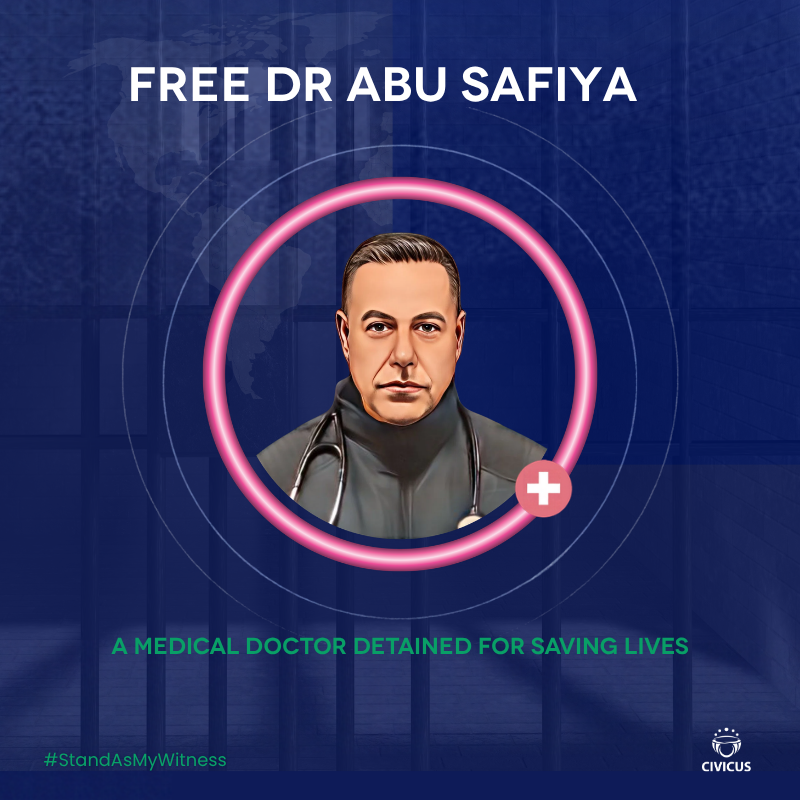
CIVICUS and Physicians for Human Rights – Israel add Dr Abu Safiya to the Stand As My Witness campaign, calling for the release of all 14 detained Gaza doctors.
Johannesburg, 21 October 2026 – Dr Hussam Abu Safiya treated children in northern Gaza until Israeli forces took him from his hospital. Almost two years on, he is still held in inhumane conditions without charge or trial, and he is not alone.
Dr Abu Safiya, a paediatrician and director of Kamal Adwan Hospital, stayed with his patients through attacks, evacuation orders, and severe medicine shortages. He was detained on 27 December 2024 and has since been held under Israel’s Unlawful Combatants Law, much of the time in solitary confinement and without adequate healthcare.
Physicians for Human Rights – Israel (PHRI) and his lawyer report repeated severe assaults and a serious decline in his health. In June 2026, Israel’s Supreme Court upheld his detention until at least October.
In July, the UN Human Rights Office called for his immediate release or, failing that, for him to be charged, given a fair trial, and urgently transferred to a civilian hospital. According to the UN, at least 13 other senior Palestinian doctors from Gaza are also detained without charge.
“Dr Abu Safiya’s case has become emblematic of what Palestinian healthcare workers in occupied Gaza are facing. But he is one of many,” said Asma Darwish, Stand As My Witness Campaign Lead at CIVICUS. “Behind his name are at least 13 other doctors deprived of their liberty without charge or trial. Their cases must not become invisible.”
The cost is felt far beyond the cells. Every doctor removed from Gaza’s health system means fewer medical workers to deliver babies, perform surgery, treat children, and train other medical workers. PHRI says hundreds of healthcare workers have been arrested since the war began. Many have been subjected to enforced disappearance, beatings, and other forms of ill-treatment. Targeted detention of this kind may amount to serious violations of international law and, if part of a widespread or systematic attack on civilians, crimes against humanity.
“Protecting healthcare workers is not a privilege; it is an obligation under international law,” said Naji Abbas of PHRI’s Detainees & Prisoners Department. “Doctors must be able to care for patients without fear of arrest, disappearance, torture or retaliation.”
CIVICUS and PHRI call for the immediate and unconditional release of Dr Abu Safiya, the 13 other detained doctors and all arbitrarily detained Palestinian healthcare workers. Until they are freed, the Israeli authorities must protect them from torture and ill-treatment. They must be guaranteed independent medical care and meaningful access to lawyers and families. The International Committee of the Red Cross and independent monitors must be granted unhindered access.
About Stand As My Witness
Launched by CIVICUS in 2020, Stand As My Witness highlights human rights defenders who are arbitrarily imprisoned or persecuted for their peaceful work and mobilises international solidarity for their protection and release. -
Rights organisation calls for release of activist Sudha Bharadwaj on 2nd anniversary of her arrest


- CIVICUS urges authorities to drop baseless charges against Sudha Bharadwaj
- There are concerns for Bharadwaj’s health in prison during COVID-19 pandemic
- Bharadwaj is featured in international campaign #StandAsMyWitness calling for release of human rights defenders
August 28 2020 marks two years since the arrest and detention of Indian activist and human rights lawyer Sudha Bharadwaj. Ahead of this second anniversary, global civil society organisation CIVICUS calls on the Indian government to immediately release Bharadwaj and drop all charges against her.
Bharadwaj has been in pre-trial detention since August 2018, when she was arrested under the draconian Unlawful Activities Prevention Act (UAPA) and accused of having links with Maoist terrorist organisations. It is also alleged that she and ten other human rights defenders were conspiring to incite Dalits, a marginalised group, at a public meeting which led to violence in Bhima Koregaon village in the Pune district of Maharashtra in January 2018.
Sudha Bharadwaj was initially held under house arrest until October 2018, when she was then moved to Byculla Women’s Prison in Mumbai. There are concerns that the 59 year old, who suffers from diabetes and hypertension, will be susceptible to COVID-19 in the cramped prison, where an inmate has already tested positive for the virus. A July medical report found that she is also now suffering from Ischemic heart disease.
Despite her underlying health issues, last week Bharadwaj’s plea for bail to the Bombay High Court was opposed by the National Investigation Agency which claimed her condition is not serious. The treatment of Bharadwaj highlights the increasingly repressive measures used by Prime Minister Narendra Modi’s government to clamp down on dissent and silence human rights defenders.
UN experts have expressed concerns about the terrorism charges laid against Sudha and about the Unlawful Activities Prevention Act’s vague definition of ‘unlawful activities’ and ‘membership of terrorist organisations’ which have been routinely used by the government to stifle dissent:
“Sudha is a lawyer and activist who has spent her life defending Indigenous people in India and protecting workers’ rights. However, her human rights activities have put her in the firing line of the Modi regime, which is abusing the Unlawful Activities Prevention Act (UAPA) and using it to round-up activists and human rights defenders on trumped-up charges,” said Josef Benedict, Asia-Pacific civic space researcher for CIVICUS.
Sudha Bharadwaj is one of a group of leading human rights defenders who feature in CIVICUS’ global campaign #StandAsMyWitness. The campaign urges people to call for an end to the imprisonment and harassment of human rights defenders across the world. People are also encouraged to share the defenders’ individual stories on social media using the hashtag #StandAsMyWitness.
ABOUT CIVICUS
CIVICUS is a global alliance of civil society organisations dedicated to strengthening citizen action and civil society around the world. CIVICUS has 10,000 members worldwide.
CIVICUS Monitor is an online platform that tracks the fundamental rights of freedom of assembly, association and expression in countries across the world. India’s civic space rating was downgraded from ‘obstructed’ to ‘repressed’ last year owing to its increased restriction of space for dissent and particularly following Prime Minister Narendra Modi’s re-election in May 2019.
INTERVIEWS
For interviews with CIVICUS please contact:
-
Rights organisations call for release of activist Teresita Naul on her first anniversary in detention

- 15 March marks one year in detention for rights activist Teresita Naul
- Philippines Human Rights Commission says Teresita was wrongfully ‘red-tagged’
- Teresita’s daughter fears for her mother’s life in prison
-
Rights organisations call for release of Teresita Naul ahead of court case & global campaign launch

- Human rights organisations call for release of Teresita Naul ahead of court case 17 July
- Naul’s family concerned about her deteriorating health in prison
- #StandAsMyWitness campaign featuring Naul and calling for release of activists in prison launches on Nelson Mandela Day 18 July
CIVICUS, World Organisation Against Torture (OMCT), Karapatan and other human rights organisations in the Philippines call for the release of Teresita Naul, a human rights defender from the Philippines, ahead of her court case on 17 July, and the launch of a global campaign featuring Naul and other imprisoned human rights defenders.
-
Risk of refoulement of asylum seeker in cooperation with Algerian authorities would mark a dangerous turning point for human rights for Tunisia

The undersigned organizations express their deep concern at the risk of refoulement of an Algerian asylum seeker - Zakaria Hannache - present in Tunisia since August 2022. Tunisian authorities must under no circumstances repeat the dangerous precedent set by the kidnapping and refoulement of Algerian refugee Slimane Bouhafs on 25 August, 2021, about which no investigation has been opened to date in Tunisia.
-
Saudi rights activist Loujain al-Hathloul spends 1000th day in prison


Today, as Saudi women’s rights activist Loujain al-Hathloul spends her 1000th day in prison, global civil society alliance CIVICUS and the Free Saudi Activists coalition call for her immediate and unconditional release.
-
Six years on from her unjust imprisonment: Freedom for Kenia Now!

October 18th marked six years since lawyer, feminist and Amuzga indigenous woman human rights defender, Kenia Inés Hernández Montalván, was arbitrarily detained, criminalised and unjustly sentenced to a total of more than 20 years in prison on eleven charges.
Kenia is an Amuzga woman and defender of land, territory, the rights of indigenous peoples and women’s rights. She is the Coordinator of the Zapata Vive Libertarian Collective, which promotes different forms of peaceful resistance against the implementation of capitalist development models.
The reason for her imprisonment? Exercising her legitimate right to protest and to defend human rights. Six years later, despite the fact that in April 2026 she was cleared of the eight federal charges against her, and despite warnings regarding the injustice of her case, from international organisations, human rights bodies and mechanisms, including the IACHR, the UN, as well as Mexican and European parliamentarians,Kenia remains in detention.
Over the past six years, Kenia has been separated from her young children and encarcerated in various prisons, including a maximum-security facility, CEFERESO 16, in the state of Morelos. Her rights have been continously violated Her rights have been continously violated, causing her to go on hunger strike on several occasions. It was particularly painful for her last year when her mother died. She was denied the right to attend the funeral and embrace her children, who had just lost the person caring for them ever since their mother was arbitrary detained.
Nevertheless, during this time, Kenia has not stopped defending her own rights or those of other female prisoners, nor has she stopped writing poetry to ensure her voice is heard beyond the prison walls. She has even set up a workshop in prison called "Weavers of Freedom". As well as sharing ancestral knowledge of weaving and beadwork with other women, it serves as a self-sustaining space and a form of occupational therapy for more than 30 women in custody, helping many of them to find new motivation and get closer to their sons and daughters.
In April 2026, the defender was cleared of the eight federal charges against her, with only two state-level cases pending in the State of Mexico. Regrettably, in July 2026, just when her release seemed closer than ever, one of the federal cases from which she had been acquitted was reopened following an appeal filed by the prosecution: Caminos y Puentes Federales (CAPUFE), a federal agency of the Mexican government.
This legal action challenges the Judge’s decision not to proceed with this case, on the premise that doing so would amount to criminalising the defence of human rights. In the Judge’s own words:"(...) the prosecution accuses Kenia of having ‘led a group of people to commit a crime’, but the only evidence it has produced is that Kenia is a leader; and having heard her, I have no doubt that Kenia is a natural leader, but to charge her simply for being a leader in her community would be to criminalise activism in Mexico, as so often happens, and that must begin to change in Mexico. We must start to rule with a human rights perspective.”
For Kenia, it has now been six years of sustained and prolonged injustice, of separation from her children, of being unable to freely carry out her tireless work and commitment to the defence of human rights. However, it has also been six years of receiving support, solidarity and recognition from many people, organisations and collectives in Mexico, Latin America and across the globe. That is why, now more than ever, we must continue to express and convey solidarity with her and her family, and demand that the authorities and relevant bodies release her immediately and close the cases against her.
FREEDOM FOR KENIA NOW!
Signed by:
Asociación por la paz y los derechos humanos Taula per Mèxic
CIVICUS, Alianza Global para la Participación Ciudadana
Federación Internacional por los Derechos Humanos (FIDH), en el marco del Observatorio
para la Protección de las Personas Defensoras de Derechos Humanos
Femena
Front Line Defenders
Global Witness
Iniciativa Mesoamericana de Mujeres Defensoras de Derechos Humanos (IM-Defensoras)
Latinas en Poder Internacional
Nobel Women’s Initiative
Organización Mundial Contra la Tortura (OMCT), en el marco del Observatorio para la
Protección de las Personas Defensoras de Derechos Humanos
Plataforma por la Paz y los Derechos Humanos México – Unión Europea
Red-DESC – Red Internacional para los Derechos Económicos, Sociales y Culturales
The Regional Coalition for Women Human Rights Defenders in South West Asia and North
Africa (WHRDMENA)
Women Human Rights Defenders International Coalition (WHRDIC)
Women's International Peace Centre
Zehar-Errefuxiatuekin -
Tajikistan: Lawyer Wrongfully Held for a Decade

Free Buzurghmer Yorov and All Others Held for Exercising their Human Rights
Tajikistan authorities have wrongfully imprisoned a human rights lawyer for 10 years for exercising his human rights, 12 organizations said today. Buzurgmehr Yorov is serving a 23-year prison sentence because of his work representing political opposition leaders.
Tajikistani authorities should quash Yorov’s conviction and sentence and release him immediately. The authorities should also release all other prisoners, including lawyers, arbitrarily and unjustifiably detained for peacefully exercising their human rights.
Yorov, 54, earned a reputation as one of the most fearless human rights lawyers in Tajikistan by taking on high-profile legal cases, representing individuals prosecuted by the government on politically motivated charges. In early September 2015, Yorov began representing several members of the Islamic Renaissance Party of Tajikistan. The party had been one of the few officially registered opposition parties in the country, but it was labeled a terrorist organization and banned in September 2015.
On September 28, 2015, police arrested Yorov, raided his home and legal office without a warrant, and ultimately charged him with forgery, fraud, “arousing national, racial, local or religious hostility,” and extremism. The charges appear to have been prompted by an interview Yorov gave shortly before his arrest in which he announced that one of his clients had been tortured in pre-trial detention and called for a coalition of lawyers to join him in representing the detained Islamic Renaissance Party members.
Yorov was held in pre-trial detention for eight months, where he was beaten and held in solitary confinement. On October 6, 2016, after a trial riddled with due process violations, he was sentenced to 23 years in prison. Since then, his sentence has twice been shortened under mass amnesties. However, authorities have repeatedly brought new, trumped-up charges against him—most recently in July 2023. The ensuing convictions have extended his sentence and pushed his expected release date to September 2043, by which time he will be 72 years old.
Like Yorov’s first trial, those that followed were rife with violations of fair-trial rights, including prohibiting Yorov from freely communicating with or receiving the assistance of counsel or presenting his own defense.
Yorov has been severely mistreated in prison, including through torture, and held incommunicado. The authorities have restricted visits from his wife and reportedly pressured his family not to advocate on his behalf. In May 2019, the UN Working Group on Arbitrary Detention issued an opinion stating that Tajikistan’s detention and treatment of Yorov violated international law and calling for his immediate release. Nevertheless, he remains in prison.
Yorov’s detention and abuse are indicative of a broader human rights crisis in Tajikistan. Under the decades-long rule of President Emomali Rahmon, the rule of law has been weakened in the country, and the authorities have become increasingly repressive. The decline accelerated further after November 2021, when the authorities initiated a violent campaign to repress protests in the Gorno-Badakhshan Autonomous Region, wiping out independent media and civil society in the region.
Dozens of lawyers, civic activists, journalists, community leaders, and others have been arrested and persecuted for politically motivated reasons in recent years, including journalists Ulfatkhonim Mamadshoeva, Mamadsulton Mavlonazarov, and Ruhshona Khakimova, and human rights lawyer, Manuchehr Kholiknazarov.
The Tajikistani authorities should release Yorov immediately and unconditionally and release all other prisoners jailed on politically motivated charges. The government should abide by its obligations under international law to protect everyone’s free and peaceful exercise of their human rights.
Tajikistan’s international partners should use bilateral and multilateral diplomacy to raise Yorov’s case and insist on his release.
SIGNATORIES:
Araminta
Amnesty International
CIVICUS: World Alliance for Citizen Participation
Civil Rights Defenders
Freedom Now
Helsinki Foundation for Human Rights
Human Rights Watch
International Bar Association’s Human Rights Institute (IBAHRI)
International Commission of Jurists
International Partnership for Human Rights
Lawyers for Lawyers (L4L)
Norwegian Helsinki Committee
-
This Mandela Day lets redouble efforts to free imprisoned human rights defenders

By Benjamin Tonga and Mandeep Tiwana
On 18 July, people in South Africa and around the world will mark Nelson Mandela Day to commemorate the courage and sacrifice of one of the greatest political leaders and human rights defenders of our times. Nelson Mandela was unjustly imprisoned for over a quarter of a century until South Africa’s apartheid regime finally acknowledged the travesty of his incarceration and ordered his release. It took concerted global pressure and organising by concerned citizens and civil society groups to achieve this feat.
-
Urgent Appeal on Critical Health of Egyptian Lawyer and Human Rights Defender Hoda Abdel-Moneim

The undersigned human rights organisations are deeply concerned over the severe deterioration in the health of lawyer and human rights defender Hoda Abdel-Moneim, 66 years old, who has been in pretrial detention since 1st of November 2018. Abdel-Moneim‘s life is imminently at risk.
According to her lawyer, Ms. Abdelmonem had two heart attacks on 23 and 30 August 2025, yet neither he nor her family were informed of her deteriorating health at the time, only learning of her condition during a subsequent visit on 6 September 2025.
In addition, Ms. Abdelmonem, who has been in detention since November 2018, suffers from cerebral arterial constriction, which left her bedridden for 12 consecutive days and completely unable to move. She also suffers from chronic deep vein thrombosis (DVT) accompanied by multiple pulmonary embolisms, requiring strict adherence to continuous treatment in order to stabilise her condition and prevent clot migration to the lungs — a potentially fatal risk. She further suffers from severe hypertension,acute inflammations in the joints and spine, and is in urgent need of knee replacement surgery. Her kidney functions have also deteriorated significantly, as her left kidney has completely ceased functioning, while her right kidney shows severe reflux. In addition, she previously suffered an angina attack while in detention, and her health continues to deteriorate due to systematic medical neglect.
On 9 September 2025, Hoda Abdel-Moneim’s family submitted a new official request to the relevant authorities for her release on medical grounds. This request was preceded by numerous other requests that went unanswered. The family further filed a complaint with the National Council for Human Rights on 13 August 2025, requesting urgent intervention to provide Abdel-Moneim with the necessary medical care and demanding her immediate release
The continuation of Abdel Monem's pre-trial detention lacks any legal basis. She has been “rotated” into two new cases — No. 800 of 2020 and No. 730 of 2020 — both carrying the same charges as Case No. 1552 of 2018 before the Supreme State Security Prosecution, in which a final and binding judgment was issued by an exceptional court. Re-imposing the same charges constitutes a blatant violation of the most basic guarantees of a fair trial.
Hoda Abdelmonem is not an individual ordeal, but rather part of a pattern of systematic violations committed by the Egyptian authorities against dissidents and human rights defenders. Prisoners in Egypt endure grave human rights abuses on a daily basis, without the slightest accountability for those responsible. These conditions have driven some detainees to attempt suicidedue to the harshness of their detention, the denial of essential medication, and the authorities’ failure to respond to medical emergencies.
The repeated “rotation” of Hoda Abdelmonem — for the third time, despite the expiry of her sentence in October 2023 — epitomizes the flagrant disregard for judicial rulings, and highlights the extent to which the fate of political prisoners and human rights defenders in Egypt is determined by the security apparatuses and their decisions, rather than by the courts. This pattern is also evident in other cases, such as that of human rights defender Ibrahim Metwally, who has been imprisoned since 2017 and is continuously “rotated” from one case to another.
Accordingly, we call on the Egyptian authorities to:
- Immediately and unconditionally release lawyer and human rights defender Hoda Abdelmonem, given the critical risk to her life and the absence of any legal basis for her continued pre-trial detention.
- Ensure her urgent transfer to a specialized hospital outside prison to receive necessary and lifesaving medical care.
- Guarantee the right of all detainees to comprehensive healthcare in line with both Egyptian constitutional requirements and international human rights standards.
Signatories:
- Egyptian Human Rights Forum (EHRF)
- Egyptian Front for Human Rights
- Law and Democracy Support Foundation (LDSF)
- CIVICUS
- EuroMed Rights Network
- The Egyptian Commission for Rights and Freedoms
- Fair Square
- Refugee Platform
- Middle East Democracy Center (MEDC)
- REDWORD for Human Rights & Freedom of Expression
- The Regional Coalition for Women Human Rights Defenders in South West Asia and North Africa (WHRDMENA)
- Sinai Foundation for Human Rights
- HuMENA for Human Rights and Civic Engagement
- Lawyers for Lawyers
- the Arabic center for judiciary independence
- MENA Rights Group
- International Bar Association’s Human Rights Institute (IBAHRI)
- The Council of Bars and Law Societies of Europe (CCBE)
- Cairo Institute for Human Rights Studies (CIHRS)
- Egyptwide for human rights
- International Service for Human Rights (ISHR)
- Egyptian Initiative for Personal Rights (EIPR)
- Digital Democracy Now
- Elnadim Center
-
Urgent call to release Abdul-Hadi al-Khawaja on his 60th Birthday &10th anniversary of his detention

To: United Nations Secretary General and diplomatic Missions
United Nations Special Rapporteurs/Targeted Governments (to be amended based on recipient)
Re: Urgent call to release Abdul-Hadi al-Khawaja on his sixtieth Birthday and Tenth anniversary of his detention
Your Excellencies,
We the undersigned, representing civil society organisations from around the world, write to bring to your urgent attention the continued detention of human rights defender Abdul-Hadi Abdulla Hubail al-Khawaja. As you may be aware, al-Khawaja, who is a dual Bahraini-Danish citizen, is currently serving a life sentence for his peaceful human rights activities. As he marks his 10th year in prison and commemorates his 60th birthday on 5 April 2021, we urge the United Nations through its Secretary General, governments around the world and representatives of the diplomatic community to urgently call on Bahraini authorities to release him immediately and unconditionally.
Al-Khawaja’s active campaigning for human rights began when he was 16 years old. Spanning decades of activism, he is the co-founder of both the Gulf Centre for Human Rights (GCHR) and the Bahrain Center for Human Rights (BCHR) for which he was also President. Until early 2011, al-Khawaja worked as MENA Protection Coordinator for human rights group Frontline Defenders. He also previously took part in a fact-finding mission to Iraq in 2003 with Amnesty International and is a member of the International Advisory Network of the Business and Human Rights Resource Centre. He is a peaceful advocate of human rights and the recipient of several human rights awards, including the “World without Torture” Award which he received in October 2013 in recognition of his struggle for human rights.
He was arrested on 9 April 2011 for his role in organising peaceful protests to defend the realisation of human rights of Bahrainis and for political reform during the popular ‘Arab Spring’ movements which began in Bahrain in February 2011. He was violently detained by security forces as detailed in a report by the Bahrain Independent Commission of Inquiry (BICI) published in November 2011 at the request of the King of Bahrain. He is serving a life prison sentence in Jau prison following unfair trials in courts that did not comply with Bahraini criminal law or international fair trial standards.
At its 63rd session in April/May 2012, the UN Working Group on Arbitrary Detention considered that al-Khawaja’s arrest was arbitrary as it resulted from his exercise of the rights to freedom of expression, association and peaceful assembly.
On 17 March 2021, GCHR in co-operation with its human rights partners Americans for Democracy & Human Rights in Bahrain (AHRDB), BCHR, the International Federation for Human Rights (FIDH), and the World Organisation Against Torture (OMCT), released a reportdetailing some of the ill-treatment and torture al-Khawaja has faced during his arrest and subsequent arbitrary detention. This has included severe physical, psychological and sexual torture.
During his early detention, al-Khawaja suffered multiple fractures to his jaw and has undergone multiple surgeries but still suffers from chronic pain and requires additional intervention as he has not healed properly. His facial bone structure is permanently damaged. In January 2021, over 100 NGOs appealed to the Danish government to help free al-Khawaja so he could travel to Denmark for treatment.
In a January 2021 phone call, al-Khawaja listed four concerns including that prison authorities placed restrictions on his phone calls with the family (that have replaced their in-person visits) and confiscated hundreds of his books and other materials. He also stated that prison authorities arbitrarily deny him adequate healthcare and refuse to refer him to specialists for the urgent surgeries he requires. Denying a prisoner needed medical care violates the United Nations Standard Minimum Rules for the Treatment of Prisoners, known as the Nelson Mandela Rules.
Al-Khawaja continues to protest the arbitrary detention to which he is subjected. Since his arrest, he has undertaken six-hunger strikes, one lasting 110 days in 2012 to protest conditions in Jau Prison and his unjust imprisonment.
In March 2020, at the start of the Covid-19 pandemic, Bahrain released 1,486 prisoners, 901 of whom received royal pardons on “humanitarian grounds.” However, al-Khawaja and other prominent human rights defenders - many of whom are older or suffer from underlying medical conditions - were not among those released.
On 11 March 2021, the European Parliament voted overwhelmingly in a plenary session to adopt an urgent resolution condemning human rights abuses in Bahrain, including the persecution of human rights defenders, lawyers and other civil society figures, while calling on Bahrain’s government to enact reforms. The resolution calls for the release of al-Khawaja and others “who have been detained and sentenced for merely exercising their right to freedom of expression.”
On al-Khawaja’s 60th birthday and the 10th anniversary of his arrest we appeal to you to personally hold talks with the government of Bahrain to immediately and unconditionally release him.
The undersigned,
- Activista Moviment
- African National Congress Youth League
- Amnesty International
- Association El Ghad pour les droits de l’homme
- Bahrain Center for Human Rights (BCHR)
- Bahrain Institute for Rights and Democracy (BIRD)
- Brothers Keeper NPO
- Bytes For All, Pakistan
- Cairo Institute for Human Rights Studies (CIHRS)
- Cambodian Center for Human Rights (CCHR)
- CIVICUS
- Community Transformation Foundation Network (COTFONE)
- Danish PEN
- FIDH, within the framework of the Observatory for the Protection of Human Rights Defenders
- Front Line Defenders
- Globe International Center, Mongolia
- Gulf Centre for Human Rights (GCHR)
- Human Rights Sentinel
- IFEX
- International Media Support
- International Service for Human Rights (ISHR)
- Intersection Association for Rights and Freedoms
- Iraqi Journalism Rights Defence Association
- Kuza Livelihood Improvement Projects
- Maharat Foundation
- Media Institute of Southern Africa
- OMCT (World Organisation Against Torture), within the framework of the Observatory for the Protection of Human Rights Defenders
- Pacific Islands News Association (PINA)
- Protection Adolescent Organization
- South East Europe Media Organisation (SEEMO)
- Syrian Center for Media and Freedom of Expression (SCM)
- The Community Human Rights Defenders Network - ACPDH
- Universidade do Minho
- Vigilance for Démocracy and Civic state
- Vigilance for Democracy and the Civic State
- منظمة الفيصل لمناهضة الاعتقال والتعذيب والإخفاء القسري (Al-Faisal Organization Against Detention, Torture and Enforced Disappearance)

CIVICUS es una alianza global que reivindica el poder de la sociedad civil para crear un cambio positivo.
 |
 |
 |
 |
 |
 |
 |