
 English
  Français
  Español
 HRC63
-
CIVICUS at the 63rd Regular Session of the Human Rights Council
Sixty-third (63rd) Session of the UN Human Rights Council (7 September to 9 October 2026)
- Overview of Priorities
- Structural Challenges at the Human Rights Council
- Thematic Priorities
- Country-Specific Priorities
Overview of Priorities
Amid intensifying civic space restrictions, civil society funding challenges and a severe UN liquidity crisis, the Human Rights Council (HRC) remains a vital space for defending human rights and amplifying the voices of those most affected.
At the 63rd session from7 Septemberto 9 October 2026, CIVICUS will focus on protecting civil society and fundamental freedoms, particularly from acts of arbitrary detention, intimidation and reprisals.
We are deeply concerned by the growing use of reprisals against those engaging with UN mechanisms. These tactics, used by states and non-state actors, are becoming more sophisticated and can lead to serious rights violations.
Arbitrary detention exposes victims to enforced disappearance, extrajudicial execution, ill-treatment and torture, and creates chilling effects on civil society movements. We will advocate for the release of activists, human rights defenders and other citizens detained unlawfully for exercising their core civic freedoms.
Crucial mandates that contribute to accountability and justice for grave human rights violations such as the Special Rapporteur on the promotion of truth, justice, reparation and the mandate on enforced or involuntary disappearances should be renewed.
Council membership processes, particularly the practice of uncontested slates, should be reformed to comply with membership criteria set out in the 2006 UN General Assembly resolution.
Amid a severe financial crisis and growing uncertainties related to the 5th cycle of the Universal Periodic Review (UPR) process, the Council must preserve a safe and meaningful space for civil society participation and develop practical recommendations for state and non-state actors for the creation of a safe and enabling environment for civil society at the national, regional, international and UN levels.
On country situations, the Council must reinforce scrutiny on Sudanfollowing the urgent debate held in July on the worsening human rights crisis around El Obeid mandating an urgent fact-finding inquiry and continue investigations into grave past and present human rights abuses and violations in Venezuela. It should renew critical mandates on Afghanistanand the Russian Federation. There will also be an interactive debate on Cambodia.
Additionally, it should renew the mandate on Burundi, ensure continued monitoring of the human rights situation in the Democratic Republic of the Congo (DRC) and take decisive steps on the human rights situation in other countries, ranging from Cambodia to Haiti, where more than technical support is needed to address the human rights crises driven by resource-based conflicts and the collapse of state authority. Finally, CIVICUS urges the Council to address urgent human rights concerns in countries not currently on its agenda, including Bahrain, Burkina Faso, Ecuador and India.
Human Rights Councilelections (2027–2029):upholdinghumanrightsstandards
As countries with poor human rights records seek seats on Human Rights Council, CIVICUS calls for genuine progress on accountability, justice and rights. Candidate states must:
✅Protect civic space through robust legal frameworks and meaningfully contribute to the enabling environment for civil society at the international level.
✅Release unjustly imprisoned human rights defenders, citizens and foreign nationals.
✅ End extraterritorial attacks and transnational repression.
Council members are expected to uphold the highest human rights standards, as set out in the 2006 UN General Assembly resolution. While civil society has been instrumental in blocking unsuitable candidates over the years, structural reforms are needed to prevent violators from gaining seats. This includes making election processes more competitive and allowing public scrutiny of candidates’ records.
Structural Challenges at the Human Rights Council
Membership
The presentation of clean slates — in which the number of candidates is equal to the number of vacant seats — undermines the Council’s quality of membership, as states with poor human rights records can easily gain a seat even if the Council’s rules require voting states to take account of each candidate’s contribution to the promotion and protection of human rights. In Asia-Pacific, Jordan and Kuwait, which are both classified by the CIVICUS Monitor as having repressed civic space, are expected to obtain a seat in the absence of competitive slots. The African bloc features Nigeria, which also has repressed civic space.
While there are no candidate states with completely closed civic space, the number of countries with repressed civic space equals that of the number with open space. Overall, the majority of states joining the Council will have stronger human rights records than those that joined previously.
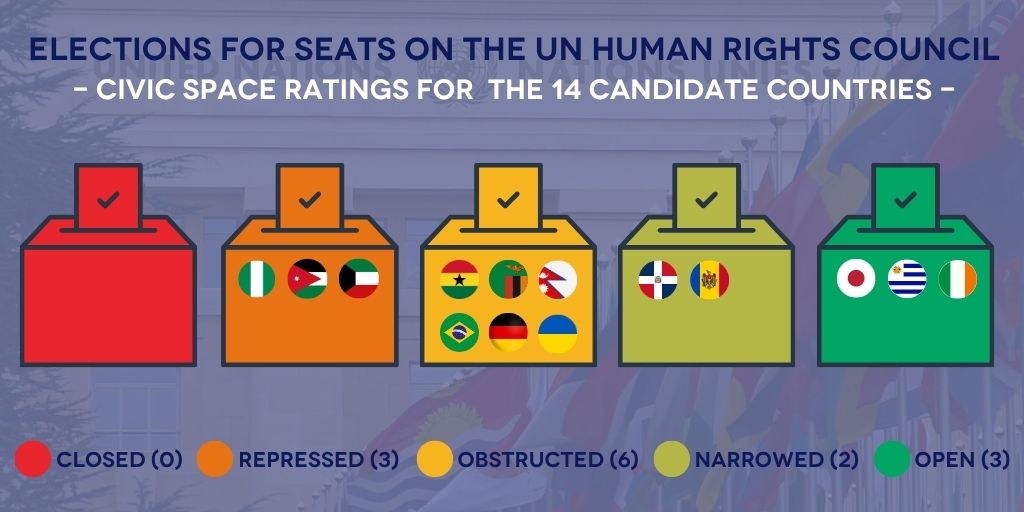
However, the credibility of membership cannot be left to chance. CIVICUS and others in civil society stress the need for competitive elections and independent scrutiny of candidates. Structural reforms should allow for open contests and empower civil society with a soft veto to enable scrutiny of states’ records in upholding human rights standards.
5th Universal Periodic Review (UPR) cycle
The UPR Working Group’s 54th session and outcome adoptions will mark the closure of the 4th cycle of the UPR, the Council’s peer-review mechanism, amid uncertainties about new procedures, protocols and timelines for civil society to present stakeholder reports under the 5th cycle.
The non-cooperation of Nicaragua and the USA with the UPR process remains a standing concern with a serious risk of a domino effect. However, other states continue to engage fully with the UPR, confirming the robustness of the mechanism and civil society’s potential to exert public pressure on states.
As we approach the 5th cycle, the UPR process should be strengthened by:
- Systematically linking UPR recommendations to country reports of Special Procedures and investigative bodies.
- Deepening engagement of civil society on the ground, including through the OHCHR’s country and regional offices.
- Reshaping the UPR report in a way that helps implementation, including streamlining recommendations.
Civicspace
-
The enabling environment: a long overdue update
In its 2025 Civil Society Space resolution, the Council requested the High Commissioner to prepare a thematic report highlighting practical recommendations for the creation and maintenance of a safe and enabling environment for civil society, based on good practices and lessons learned. At this session, the report identifying new and emerging trends concerning civil society space, including through an analysis of the specific risks faced by underrepresented parts of civil society, will be presented. It is our position that the five areas outlined in the 2016 report should be further expanded to reflect current, new, and emerging trends.
The 10 main areas the report should consider are the following:
- Supportive legal framework and effective access to remedies and justice.
- Conducive public and political environment.
- Access to information and technology, including AI-driven technology.
- Participation in policy development, planning and decision-making, including at the international level.
- Intimidation and reprisals for cooperation with the UN.
- Extraterritorial attacks and transnational repression.
- Dual challenges of civic space restrictions and structural discrimination.
- International solidarity.
- Long-term support and resourcing for civil society organisations (CSOs).
- Recommendations targeting states, non-state actors, the UN and other international organisations.
-
Groundbreaking reports: SLAPPsand technology
In 2024, the Council requested the OHCHR to prepare a report on the impact of the use of strategic lawsuits against public participation (SLAPPS) on the enjoyment and realisation of human rights, particularly the right to freedom of opinion and expression. The outcomes will be presented at this session. Additionally, a report on due diligence and improved responses to the risks to human rights defenders created by digital technologies, including people exposed to discrimination and working in situations of armed conflict, will be presented.
-
Civil society participationin the Council
Exceptional provisional measures will continue to limit civil society participation and engagement at this session. While most informal consultations on resolutions are now held exclusively in person, CSOs are limited to a maximum of three written statements as an exceptional and provisional measure. The limitation to three statements per organisation should remain strictly provisional and exceptional.
Financial crisis
The UN’s financial crisis continues to undermine the Council’s work, affecting key mechanisms, including investigative bodies and independent Special Procedures, which are vital avenue for international and local civil society.
While there has been an increase in activities related to technical cooperation and in engagement, with regional mechanisms and Special Procedures having conducted 50 country visits across 40 countries and released around 800 communications, the impact of the liquidity crisis remains dire. Recent cuts are compounded by the UN80 process, with mandate review criteria and impact on Special Procedures currently under discussion. Any changes to mandates should be carefully assessed and made in consultation with civil society at all levels.
Commissions of Inquiry and Fact-Finding Missions continue their work with reduced delivery while the Commission of Inquiry on the DRC and the Independent Investigative Mechanism for Afghanistan are the most affected mechanisms. A bright spot comes from the Judicial Cooperation Section, which was recently strengthened.
Thematic Priorities
At this 63rd session, the Council will discuss a range of civil, political, economic, social and cultural rights through dedicated debates with the mandate holders and the High Commissioner. CIVICUS will mainly make interventions related to the following thematic areas:
Reprisals for cooperation with the UN
Reprisals against those engaging with the UN, including activists, human rights defenders and other citizens, are escalating. These include intimidation, surveillance, torture and travel bans. Such acts undermine civic space and threaten the integrity of the UN human rights system.
Multi-stakeholder collaboration is needed to prevent reprisals and ensure that civil society can contribute safely to UN processes at the country and global levels. There is a need to advance a victim-centred and prevention-focused approach and improve links to other frameworks, including Human Rights Council elections.
We call onstates to:
- Guarantee unhindered access to UN bodies.
- Treat reprisals as early warning signs of civic space deterioration.
- Condemn new forms of reprisals, such as smear campaigns and travel bans, and support prevention of reprisals carried out by states and others outside their own jurisdiction.
- Strengthen civil society focal points on reprisals across allUN entities.
- Strengthen monitoring and reporting of intimidation and harassment.
- Highlight cases during dialogues, particularly where reprisals link to arbitrary detention.
Arbitrary Detention
Arbitrary detention remains one of the most widespread violations of civic freedoms globally. Human rights defenders, journalists, protesters and other citizens are being detained in at least 82 countries, often to suppress dissent.
The detention of activists and protesters has become one of the main methods states use to silence those who dissent or publicly disagree with them. Authorities are increasingly using detention as a first response to peaceful protest rather than a last resort, with security forces routinely arresting protesters who demand accountability, climate justice and democratic reform. The detention of protesters was the single most prevalent civic space violation documented by the CIVICUS Monitor in 2025, followed by the detention of journalists and human rights defenders. The scale of detentions is growing, with mass arrests of hundreds of protesters at a time documented across every region. Our Stand As My Witness campaign highlights urgent cases and the need for a clear action plan to end arbitrary detention.
We encouragestates to:
- Use interactive dialogues to spotlight specific cases and call for releases.
- Unconditionally release all those arbitrarily detained.
- Investigate all allegations and ensure accountability and justice.
- Address detentions linked to cooperation with UN mechanisms.
- Urge the immediate and unconditional release of all people detained for legitimately exercising their rights to association, expression and peaceful assembly.
At the 63rd session, CIVICUS will spotlight country-specific situations where civic space is under threat or where urgent action is needed to protect fundamental freedoms. Our interventions will focus on country situations on the Council’s agenda and country situations that are not addressed by the Council but require its attention.
A. Country situations on Council agenda
Several country situations are scheduled for discussion during this Council session. CIVICUS will engage in these discussions to highlight civic space violations and push for stronger Council action. These include:
Country Civic space rating Key issues Recommended actions for states Afghanistan Closed Since the Taliban takeover, the de facto authorities continue to commit human rights violations and crimes under international law against the Afghan people, particularly women and girls. - Arbitrary arrests and detentions persist, amid enforced disappearances, ill-treatment and torture and criminalisation of civil society, journalists and women human rights defenders.
- Authorities widely use broad ‘morality’ and ‘national security’ charges to detain activists, critics, journalists and women protesters.
- Censorship and raids on media outlets are deepening information control.
- Peaceful protests, particularly by women, are violently dispersed, with excessive force and reprisals.
- Gender-oppressive decrees exclude women and girls from education, public life and work, amounting to gender apartheid.
- Demand an end to arbitrary arrests, enforced disappearances, ill-treatment, torture and criminalisation of civil society, journalists and women human rights defenders.
- Condemn the new Criminal Procedure Code and all decrees used to silence activists, critics and media workers.
- Ensure full and safe access for UN human rights mechanisms and support the independent investigative mechanism on Afghanistan.
- Strengthen the human rights mandate of the United Nations Assistance Mission in Afghanistan and support the re-establishment of a fully mandated OHCHR presence with access for Afghan women staff.
- Ensure that the international accountability mechanism established by the Council is adequately resourced and supported to implement its crucial mandate, with meaningful Afghan civil society participation, including women.
Russia Closed Russia’s civic space remains closed since the beginning of its full-scale war against Ukraine, while systematic criminalisation, detention and harassment of activists, human rights defenders and independent journalists continue. - Wartime legislation criminalises criticism of the authorities and any dissent related to Russia’s war against Ukraine, leading to long prison sentences for peaceful expression.
- Authorities block and censor social media platforms and independent news sites, with pervasive surveillance and prosecution for online posts.
- Peaceful protests are banned nationwide and anti-war demonstrations are met with excessive force, intimidation and mass arrests.
- Cultural organisations, human rights groups and media outlets face asset seizures, closure, criminal charges and raids under ‘discrediting the army’ and ‘extremism’ provisions.
- Demand an end to arbitrary arrests, politically motivated prosecutions and criminalisation of anti-war activists, civil society and journalists.
- Condemn the Foreign Agents Law, ‘extremism’ provisions and all wartime legislation used to silence dissent.
- Call for full, safe and independent access for UN human rights mechanisms and support international accountability efforts for violations committed in Russia’s war against Ukraine.
- Urge the repeal of laws enabling censorship, internet blocking and surveillance, and demand restoration of digital rights and media freedom.
- Consider establishing or strengthening international independent mechanisms to document violations, protect at-risk activists and support future transitional justice processes.
Sudan Closed Since the outbreak of civil war in April 2023, Sudan’s civic space has collapsed, and warring parties are responsible for widespread attacks on activists, humanitarian workers, human rights defenders and journalists. - Both main parties in the conflict are responsible for arbitrary arrests, enforced disappearances, torture and targeting of civil society personnel, including community leaders.
- Media outlets face intimidation, raids and shutdowns, and humanitarian workers and journalists who report abuses are assaulted and detained.
- Digital surveillance, internet blackouts and social media restrictions severely limit access to information and obstruct documentation of violations.
- Humanitarian organisations and local civil society face movement restrictions, obstruction of aid delivery and violence, worsening the protection crisis.
- Women community activists and human rights defenders face heightened risks, including conflict-related sexual violence, reprisals and targeted intimidation.
- Demand an end to arbitrary arrests, enforced disappearances and attacks on civil society, humanitarian workers and journalists.
- Condemn all decrees, laws and military practices used to block civic mobilisation, criminalise dissent and restrict media.
- Ensure full, safe and independent access for UN human rights mechanisms and support international investigations into violations by all parties.
- Support restoration of independent media, protection of digital rights and immediate lifting of internet and social media restrictions.
- Strengthen the Independent International Fact-Finding Mission for Sudan as an international independent accountability mechanism with meaningful Sudanese civil society participation, including by women and displaced communities.
Venezuela Closed Civic space remains severely restricted, with ongoing arbitrary detentions of activists, critics, journalists and political opponents. - Authorities continue to use restrictive laws, including the Anti-Hate Law, NGO Law, Simón Bolívar Law and antiterrorism provisions to criminalise independent civil society and silence dissent.
- The government deploys intimidation and surveillance tactics against CSOs, human rights defenders and media outlets, creating an environment of fear and self-censorship.
- Blocking and censorship of digital platforms continue, with independent media and online content routinely restricted or shut down.
- Judicial harassment and politically motivated prosecutions are used to suppress opposition voices and dismantle independent civic organising.
- Demand an end to arbitrary detentions and criminalisation of civil society, critics, journalists and political opponents.
- Condemn restrictive laws, including the NGO Law and anti-terrorism provisions, that are used to silence critics and human rights defenders.
- Ensure CSOs, aid workers and volunteers can provide assistance without reprisals.
- Facilitate full, safe and independent access to UN human rights mechanisms and support international investigative processes.
- Urge restoration of media freedom, including lifting of censorship, digital blocking and restrictions on independent journalism.
- Strengthen an international independent mechanism with meaningful civil society participation to advance accountability, victim-centred transitional justice and institutional reform efforts.
Country situations that require Council attention
Beyond the countries officially on the Council's agenda, there are critical civic space crises that remain unaddressed. CIVICUS urges the Council to consider these overlooked or emerging situations:
Country Civic Space Rating Key Issues Recommended Actions for States Bahrain Closed Civic space has narrowed further as authorities use the war on Iran to criminalise defenders amid impunity, continuous reports of arbitrary detentions and torture and ill-treatment in detention. - Mass arrests of defenders, political leaders, religious figures and online critics continue since the war on Iran, with at least 200 detained over social media posts and peaceful protest, held incommunicado.
- Charges of “spreading false news,” “glorifying terrorism” and “undermining public order” remain common, with sentences up to ten years and one life term.
- Death and torture in custody have been reported.
- Citizenship was revoked from 69 people in April 2026, over half children, leaving 46 stateless, without due process.
- Call for the release of all detained for peaceful expression and an end to incommunicado detention.
- Condemn the misuse of false news, terrorism and public order charges to silence dissent.
- Demand independent investigations into deaths and torture in custody.
- Urge reversal of arbitrary citizenship revocations and an end to deportations leaving people stateless.
Burkina Faso Repressed Freedom of association has been severely restricted and over 1,100 CSOs and all political parties have been dissolved or suspended, while media bans, forced conscription and enforced disappearances silence remaining dissent. - At least 1,174 CSOs have been suspended or dissolved between April and June 2026, including 118 before the legal compliance deadline.
- The largest student union and of religious. associations have been suspended for exercising their legitimate right to freedom of expression.
- All political parties were dissolved in January 2026, with their assets. transferred to the State
- Media censorship, forced conscription and enforced disappearances of critics continue unabated.
- The UN Human Rights Office was suspended in February 2026, while withdrawal from the ICC was initiated.
- Urge to restore the legal status of dissolved and suspended CSOs and align 2025 association law with international standards on freedom of association.
- Call for the restoration of political pluralism.
- Urge an end to reprisals against unions, students and religious. associations, and the release of those detained for criticism.
- Demand an end to forced conscription and enforced disappearances.
- Urge reinstatement of the OHCHR country office and continued cooperation with international justice mechanisms.
India Repressed Civic space continues to deteriorate as counterterrorism and foreign funding laws are used to jail defenders and constrain CSOs while protests are met with excessive force and press freedom erodes through prosecutions, censorship and high restrictions in Jammu & Kashmir. - Defenders are detained without warrants and subjected to torture in custody; prolonged pre-trial detention and repeated bail denials have been documented.
- Excessive force and mass detentions have been registered during protests, alongside internet shutdowns.
- Journalists are routinely imprisoned, attacked and investigated under anti-terror law.
- Foreign funding laws (FCRA) have been amended to control CSOs assets and bar activities deemed “political”.
- Repression in Jammu & Kashmir continue, including through Internet throttling, arrests of publishers, and charges under the Unlawful Activities (Prevention) Act (UAPA).
- Call for the release of defenders and journalists detained under the UAPA, and the dropping of all politically motivated charges.
- Urge investigations and accountability for torture and excessive force used against protesters.
- Call for the repeal of the UAPA, review of the FCRA and ensure civil society can access foreign funding without undue restrictions.
- Urge withdrawal of the proposed IT rules and an end to censorship of media and publishers
- Call for an end to internet shutdowns and restoration of civic freedoms in Jammu and Kashmir.
Ecuador Obstructed Civic space continues to deteriorate as the state of emergency and a declared ‘internal armed conflict’ expand military powers, while defenders are killed and criminalised and journalists face increasing attacks. - Executive Decrees of June and July 2026 renewed the “internal armed conflict” and introduced an overly broad concept of ‘violent extremism’ targeting Indigenous people organisations, unions, students and protesters
- At least nine environmental defenders were killed between 2025 and 2026.
- CSO bank accounts have been frozen without notice under the 2025 Social Transparency Law, including Unión de Organizaciones Campesinas e Indígenas de Cotacach (UNORCAC).
- Six journalists were killed in 2025 alone.
- Opposition parties have been suspended or deregistered ahead of the November 2026 local elections.
- Call for the revision of the 2025 Social Transparency Law, the National Comprehensive Security Plan 2025-2029, including its overly broad concept of ‘violent extremism’, and other legislation that imposes unlawful restrictions on CSOs.
- Call for an end to the criminalisation and stigmatisation of environmental defenders and Indigenous organisations.
- Demand independent investigations into the killings of defenders and journalists and effective protection measures.
- Call for guarantees of press freedom and an end to legal harassment of independent media.
- Stress that all political parties have the right to participate in the November 2026 elections.
For additional information on CIVICUS’ engagement during the 63rd session of the Human Rights Council or any related queries, please contact the Geneva team at .

CIVICUS is a global alliance that champions the power of civil society to create positive change.
 |
 |
 |
 |
 |
 |
 |