citizen action
-
Civil society in a world of crisis: 2023 CIVICUS State of Civil Society Report

Civil society faces a world of challenges in 2023. Multiple conflicts and crises – including economic strife and severe setbacks in democratic institutions – are intensifying threats to human rights. The agenda for civil society is huge.
This is the world as captured by the 2023 State of Civil Society Report.
VIEW THE REPORT in ARABIC | ENGLISH| FRENCH | PORTUGUESE | SPANISH
Vast-scale human rights abuses are being committed in Ukraine, women’s rights have been trampled on in Afghanistan and LGBTQI+ people’s rights are under assault in Uganda, along with several other African countries. Military rule has been normalised in countries such as Mali, Myanmar and Sudan, and democracy undermined by autocratic leaders in El Salvador, India and Tunisia, among others. Even supposedly democratic states such as Australia and the UK are undermining the vital right to protest.
But civil society continues to strive to make a crucial difference to people’s lives. It’s the force behind a wave of breakthroughs in respecting abortion rights in Latin America, most recently in Colombia, and in making advances in LGBTQI+ rights in countries as diverse as Barbados, Mexico and Switzerland. Mass protests in response to the high cost of living have won concessions on economic policy in countries including Ecuador and Panama, while union organising has gained further momentum in holding big-brand companies such as Amazon and Starbucks to account. Progress on financing for the loss and damage caused by climate change came after extensive civil society advocacy. The events of the past year show that civil society – and the space for civil society to act – are needed more than ever.
Key findings
Civil society is playing a key role in responding to conflicts and humanitarian crises – and facing retaliation
Civil society is playing a vital role in conflict and crisis settings – including in conflicts in Ethiopia, Syria and Ukraine – providing essential services, helping and advocating for victims, monitoring human rights and collecting evidence of violations to hold those responsible to account. But for doing this, civil society is coming under attack.
Catastrophic global governance failures highlight the urgency of reform
Too often in the face of the conflicts and crises that have marked the world over the past year, platitudes are all international institutions have had to offer. Multilateral institutions have been left exposed by Russia’s invasion of Ukraine. It’s time to take civil society’s proposals to make the United Nations more democratic seriously – starting with the appointment of a civil society champion.
People are mobilising in great numbers in response to economic shock – and exposing deeper problems in the process.
As it drove a surge in fuel and food prices, Russia’s war on Ukraine became a key driver of a global cost of living crisis. This triggered a mass wave of protests in at least 133 countries – from Argentina to Indonesia and from Ghana to Kazakhstan – demanding economic justice. Civil society is putting forward progressive economic ideas, connecting with other struggles for rights, including for climate, gender, racial and social justice.
The right to protest is under attack – even in longstanding democracies
Many states, unwilling or unable to concede the deeper demands of protests have responded with violence, including in Iran, Sierra Leone and Sri Lanka. The right to protest is under attack all over the world, including when people are mobilising to seek economic justice, democracy, human rights and environmental action. Civil society groups are striving to defend protest rights.
Democracy is being eroded in multiple ways – including from within by elected leaders
Economic strife and insecurity are providing fertile ground for the emergence of authoritarian leaders. In more democratic contexts, there are distinct trends of a further embrace of far-right extremism, and of the rejection of incumbency. In volatile conditions, civil society is working to resist regression and keep making the case for inclusive, pluralist and participatory democracy.
Disinformation is skewing public discourse, undermining democracy and fuelling hate
Disinformation is being mobilised, particularly in conflicts and during elections, to sow polarisation, normalise extremism and attack rights. Powerful authoritarian states and far-right groups are key sources, and social media companies are doing nothing to challenge a problem that’s good for their business model. Civil society needs to forge a joined-up, multifaceted global effort to counter disinformation.
Movements for women’s and LGBTQI+ rights are making gains against the odds
In the face of difficult odds, civil society continues to drive progress on women’s and LGBTQI+ rights. But breakthroughs have made civil society the target of a ferocious backlash. Civil society is working to resist attempts to reverse gains and build public support to ensure that legal changes are backed by shifts in attitudes.
Civil society is the major force behind the push for climate action
Civil society continues to be the force sounding the alarm on the triple threat of climate change, pollution and biodiversity loss. Civil society is urging action using every tactic available, from street protest and direct action to litigation and advocacy in national and global arenas. But the power of the fossil fuel lobby remains undimmed and restrictions on climate protests are burgeoning. Civil society is striving to find new ways to communicate the urgent need for action.
Civil society is reinventing itself to adapt to a changing world
In the context of pressures on civic space and huge global challenges, civil society is growing, diversifying and widening its repertoire of tactics. Drawing on its special strengths of diversity, adaptability and creativity, civil society continues to evolve. Much of civil society’s radical energy is coming from small, informal groups, often formed and led by women, young people and Indigenous people. There is a need to support and nurture these.
About this report
This is the 12th report in our annually published series, exploring trends in civil society action at every level and in every arena. It builds on our ongoing analysis initiative, CIVICUS Lens, launched in January 2022. It is directly informed by the voices of civil society affected by and responding to the major issues and challenges of the day, drawing from over 180 civil society interviews published throughout the year.
About CIVICUS
CIVICUS is a global alliance of civil society activists and organisations dedicated to strengthening citizen action and civil society throughout the world. CIVICUS has over 153000 members in over 189 countries across the globe.
-
Scenario planning for agile strategic alignment
By Tamryn Lee Fourie, Jerusha Govender and Khotso Tsotsotso
For CIVICUS, and civil society as a whole, the COVID-19 pandemic drastically shifted the way we work, and the world we work in. Keeping this in mind, moving towards the end of the Alliance’s current Strategic Plan 2017-2022, we asked ourselves – how can we stay strategically relevant, given the lack of clarity on what lies ahead, and realising the already stretched capacity of staff and membership?
In these uncertain times, Foresight Approaches such as scenario planning, are one potential tool for strategy development, and is a key element of CIVICUS Alliance current strategic realignment process.
Across February and March 2021, we engaged Data Innovators to review existing foresight analysis and scenario planning documents from members and partners, interact with CIVICUS members, and produce future scenarios related to civic space and citizen action. We then sense-checked these scenarios with allies from other sectors to identify potential disruptors and strategic opportunities that we may have missed.
The Scenarios
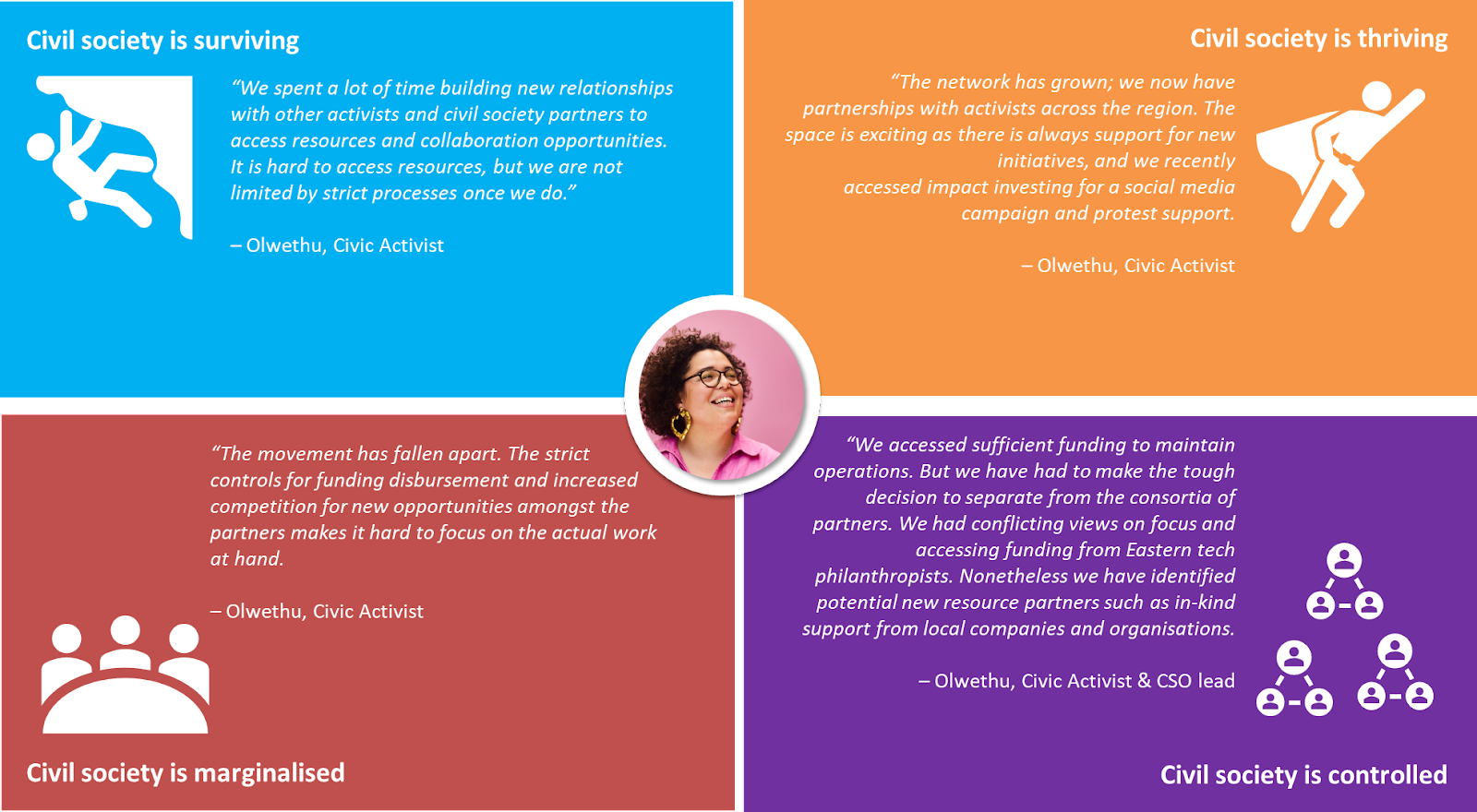
Four scenarios emerged to guide CIVICUS leadership and support other CSOs in similar stages of reviewing strategy, documented from the perspective of ‘Olwethu’, a civic activist and our persona. The four scenarios are summarised below:
Read more about the scenarios here
These scenarios are helping CIVICUS to unpack necessary amendments to our existing strategy, use the four potential futures to open discussion on where specific implementation focus is needed, and keep our constituents (i.e. “Olwethu”) at the centre. Similarly, other CSOs may also find these scenarios useful when considering strategic refinement.
How you can use these scenarios to realign your own strategies:
This exercise stress-tests current strategies for different contexts. It is good practice to identify "No brainers,” - strategies robust across the range of scenarios. However, scenarios may also be sufficiently diverse to require strategies unique to each context.
Recommended steps to test strategies against these scenarios:
Step 1:Take one scenario at a time, for a moment, assume this scenario occurs. Discuss and explore different aspects, ensuring all participants understand the critical elements.
Step 2:Once the scenario is understood, pose the following questions and document the responses:
- Is your set of strategic objectives appropriate in the scenario?
- What obvious gaps are there in the current strategy for the scenario?
- What additional/alternative strategies should be developed to close the gaps?
- Considering the gaps/alternatives, how should the Theory of Change (ToC) be adjusted?
Step 3:Repeat steps one and two for each scenario until all scenarios are covered.
If you have sufficient time, move on to step 4…
Step 4:Stand back, look at the lists of strategic options for each scenario. Identify those that show up on all or most scenarios. These are the "no brainers," the strategic options that look good in all scenarios. Start working on a consolidated Theory of Change that draws on the common strategic options, with gaps covered/replaced by alternative strategies. Take steps to address potential bias by asking those outside your regular “circle” to review and validate your work.
Step 5:Test the ToC for logic and refine it. And finally, update the current strategy.
We hope you find these useful! Please let us know if you have any feedback on how you have used these scenarios in your strategy reviews. We would be most interested to hear your experiences and insights!