


Reports and Publications
-
New report looks at the state of civic freedoms in Chile
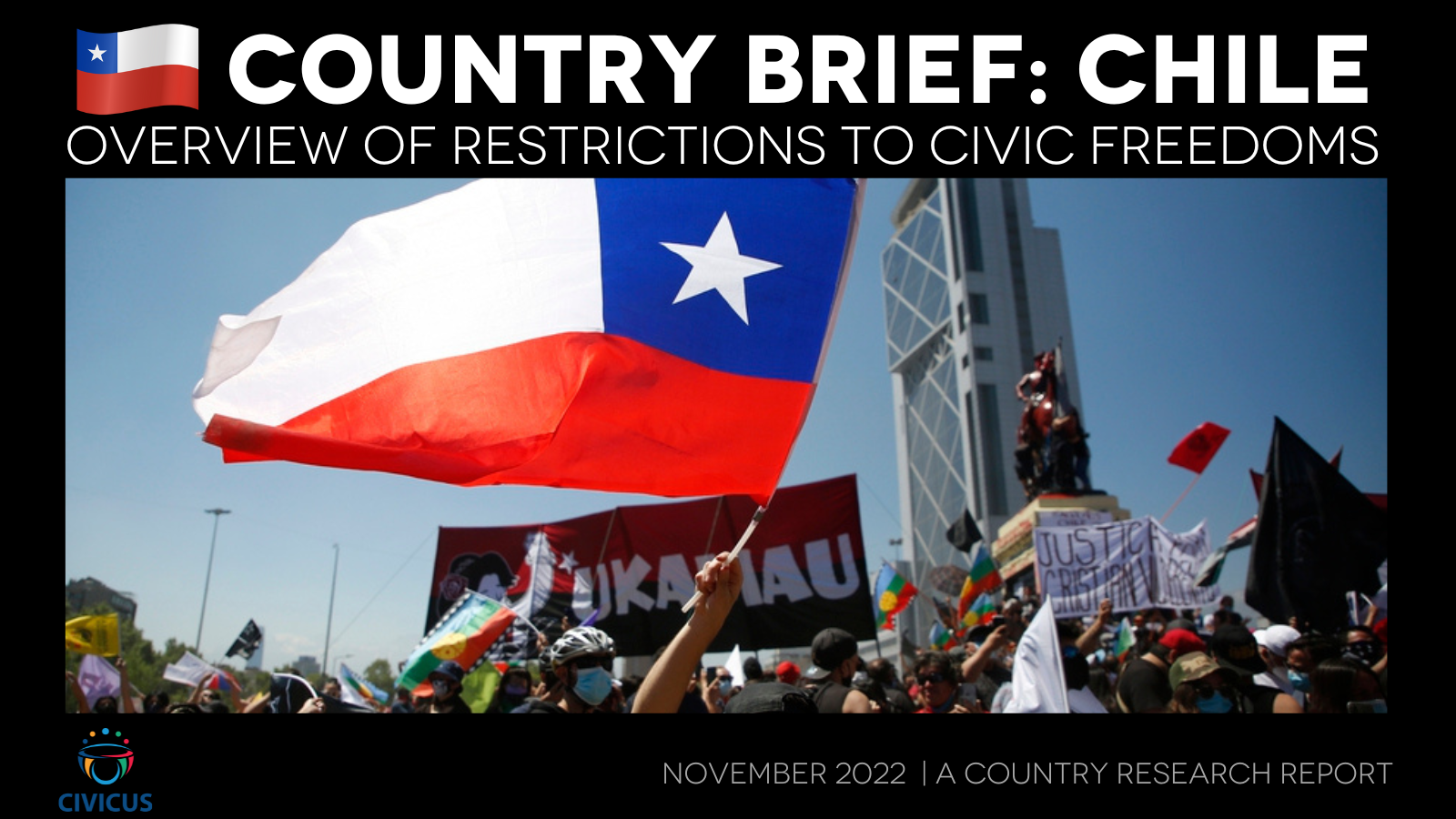
In October 2019, student protests in Santiago over a public transport price increase gave rise to a mass, nationwide display of discontent over social inequality and discrimination. Over the course of several weeks, millions of people joined protests in what is commonly referred to as Chile’s ‘estallido social’ (social unrest or uprising). At the time, protesters raised historical demands, including the recognition of Indigenous peoples’ collective rights, decent pension guarantees and access to water, quality housing, education and healthcare.
 This was a transformative period in Chile’s history which exposed deep-rooted dissatisfaction with the enduring legacy of the Pinochet dictatorship that governed Chile from 1974 to 1990, showing that structural changes are long overdue. Many called for a new social pact founded on human dignity and pluralism, pointing to the need to change the current constitution, which dates back to the country’s military regime.
A process to develop a new constitution emerged as a key demand of the protests and in October 2020, Chilean voters approved the creation of a directly elected Constitutional Convention, which began its work in July 2021. The body was praised for its diverse composition, with guaranteed gender parity and reserved seats for Indigenous representatives. While the process was launched with high hopes, confidence in the Convention gradually eroded and support for the progressive draft constitution it developed declined over time. On 4 September 2022, an overwhelming majority of Chileans rejected the adoption of the proposed constitution.
While this leaves the country in uncertainty as to how this process will continue, authorities in the government and the National Congress have asserted that they still intend to find a path forward for a new constitution.
This research brief summarises the situation of civic space in Chile between August 2020 and August 2022, reviewing emblematic cases, the main violations and positive developments regarding freedoms of peaceful assembly, association and expression. This period encompasses the final years of the government of President Sebastián Piñera, from March 2018 to March 2022, and the first months of the administration of President Gabriel Boric, since March 2022.
More information
Download the Chile research brief here.
Chile is currently rated Obstructed by the CIVICUS Monitor. There are a total of 42 other countries in the world with this rating (see all). This rating is typically given to countries where the state generally allows individuals and civil society organisations to exercise their rights to peaceful assembly, freedom of speech and freedom of association, but violations of these rights also take place (see the full description of ratings)
-
New report looks at the state of civic freedoms in the United States

In December 2020, the USA’s civic space rating was downgraded from narrowed to obstructed by the CIVICUS Monitor, signalling significant increased restrictions on the exercise of civic freedoms. This reflected the militarised and repressive response to mass protests for racial justice throughout that year, as well as the long-term trend of civic space regression through anti-protest legislation, a hostile climate for the press and surveillance, among other factors.
 On 21 January 2021, Joe Biden took office as president – only two weeks after rioters stormed the US Capitol in an attempt to overturn his election. The unrest on 6 January followed weeks of incendiary rhetoric from outgoing president Donald Trump and allies, rousing supporters to reject election results. This attack exposed the depth of the crisis in US democracy, which has impacted on the space for civil society.
While the Biden administration has sought to improve on his predecessor’s relationship with the media and stressed the importance of democratic institutions, some of these trends endure. Lawmakers, particularly those at the state level, have continued to propose and enact restrictions on protest. Recent months have also seen a slew of state-level bills limiting free speech in classrooms. Attacks on journalists are ongoing and distrust toward the press remains high. Protesters continue to face incidents of excessive force and arbitrary arrests.
This research brief covers restrictions, violations and trends affecting freedoms of association, peaceful assembly and expression in the USA between January 2021 and September 2022.
More information
Download the United States research brief here.
United States is currently rated Obstructed by the CIVICUS Monitor. There are a total of 42 other countries in the world with this rating (see all). This rating is typically given to countries where the state generally allows individuals and civil society organisations to exercise their rights to peaceful assembly, freedom of speech and freedom of association, but violations of these rights also take place (see the full description of ratings)
-
New Report: 6 in 10 countries now seriously repressing civic freedoms

Findings based on data released today by the CIVICUS Monitor a global research collaboration which rates and tracks the respect for fundamental freedoms in 196 countries.
CIVICUS has today released People Power Under Attack 2018, a new report showing that nearly six in ten countries are seriously restricting people’s fundamental freedoms of association, peaceful assembly and expression. This reflects a continuing crisis facing civil society organisations and activists across the world, with the space for civic activism most commonly undermined through censorship, attacks on journalists and harassment of human rights defenders.
“This data is a wake-up call. Given the scale of the problem, global leaders, including the G20 who are meeting this week, need to take the protection of civic freedoms far more seriously,” said Cathal Gilbert, Civic Space Research Lead at CIVICUS. “For civil society, 2018 was a story of states innovating to suppress and restrict criticism by those who dare to challenge people in power.”
The report, which is based on data from the CIVICUS Monitor - a global research collaboration - shows that civil society is under serious attack in 111 out of 196 countries. This is up from 109 countries at our last update in March 2018. In practice, this means that repression of peaceful civic activism continues to represent a widespread crisis for civil society in all parts of the world, with just 4% of the world’s population living in countries where governments are properly respecting the freedoms of association, peaceful assembly and expression.


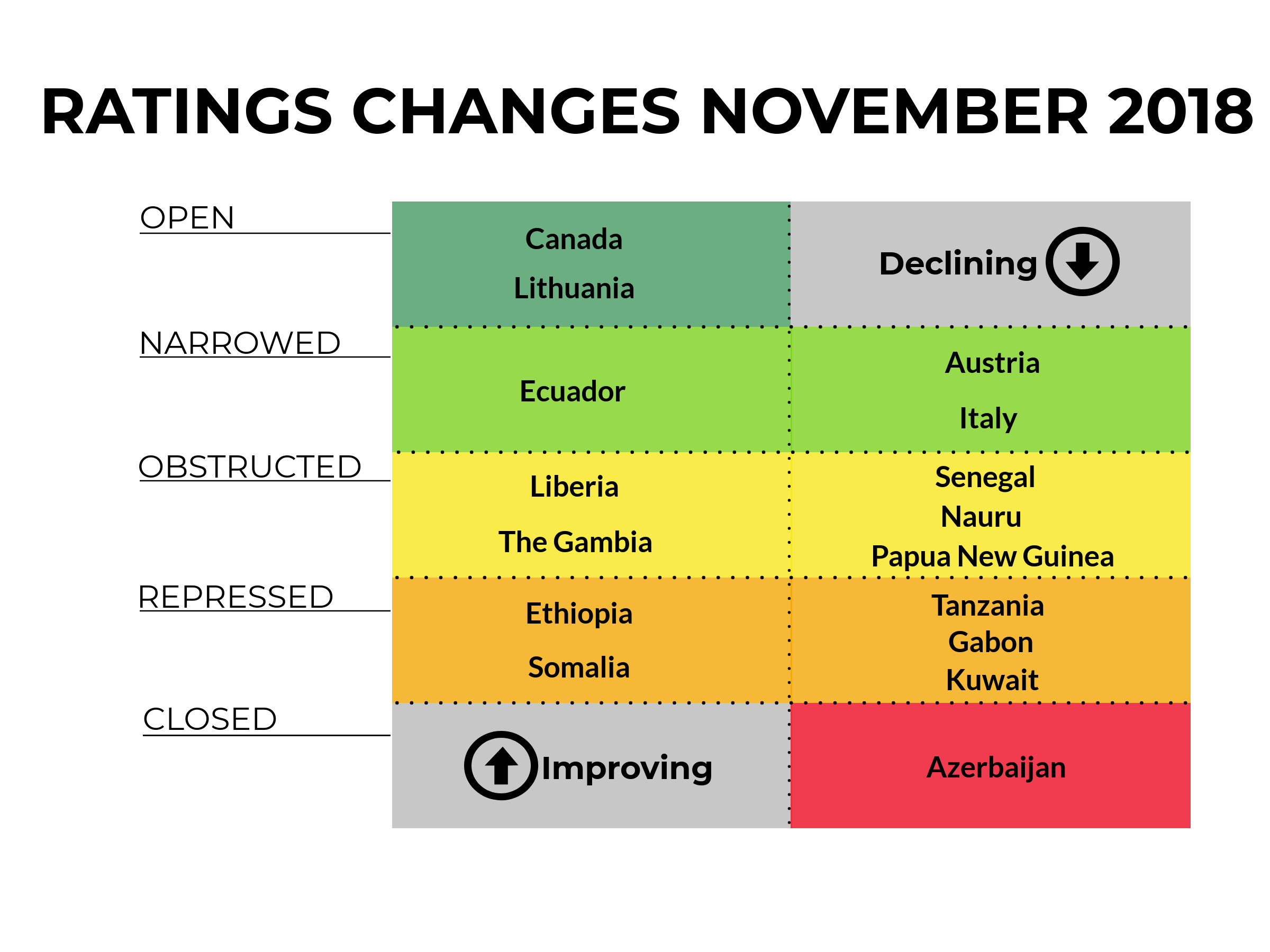
Nine countries’ civic space ratings have worsened in this latest update, while seven countries improved their ratings. Countries on the slide include Austria, Azerbaijan, Gabon, Kuwait, Italy, Nauru, Papua New Guinea, Tanzania and Senegal. Those improving are Canada, Ecuador, Ethiopia, Gambia, Liberia, Lithuania and Somalia.
People Power Under Attack 2018 also provides analysis of the kinds of violations most frequently recorded on the CIVICUS Monitor over the past two years. Globally, attacks on journalists and censorship are the two most common violations, indicating that power holders are going to great lengths to control public narratives and repress freedom of expression. Harassment of activists and the use of excessive force by security forces during protests are the third and fourth most common violations recorded on the CIVICUS Monitor since October 2016.

“While there is rightly a lot of concern about the proliferation of bad laws which stifle civic freedoms, our data shows these are just the tip of the iceberg. Extra-legal measures, such as attacking journalists or beating up protestors, are much more common,” said Gilbert. “These tactics are cynically designed to create a chilling effect and deter others from speaking out or becoming active citizens.”
CIVICUS data released today also contains good news stories. In the seven countries which improved their civic space ratings, and elsewhere, we see clear evidence that peaceful activism can force repressive governments to take a different path. In Ethiopia, for instance, following years of popular unrest and the severe repression of all forms of dissent, 2018 has witnessed a remarkable about-turn. New prime minister Abiy Ahmed has released political prisoners, eased restrictions on electronic communication and made important progress towards reforming some the country's most repressive laws. Changes in political leadership in Gambia and Ecuador have similarly led to an improved environment for the exercise of fundamental freedoms.
“Recent improvements in Ethiopia show what is possible when political will is present and leaders take courageous decisions to respond to the calls of civil society,” said Gilbert. “This should encourage those seeking change in repressive countries everywhere. By removing restrictions and protecting civic space, countries can tap into civil society’s true potential and accelerate progress on a wide range of fronts.”
Over twenty organisations collaborate on the CIVICUS Monitor to provide an evidence base for action to improve civic space on all continents. The Monitor has published more than 1,400 civic space updates in the last two years, data which is analysed in People Power Under Attack 2018. Civic space in 196 countries is categorised as either closed, repressed, obstructed, narrowed or open, based on a methodology which combines several sources of data on the freedoms of association, peaceful assembly and expression.
Regional press statements:
For more information or to arrange an interview, please contact:
Cathal Gilbert, Civic Space Research Lead, CIVICUS,